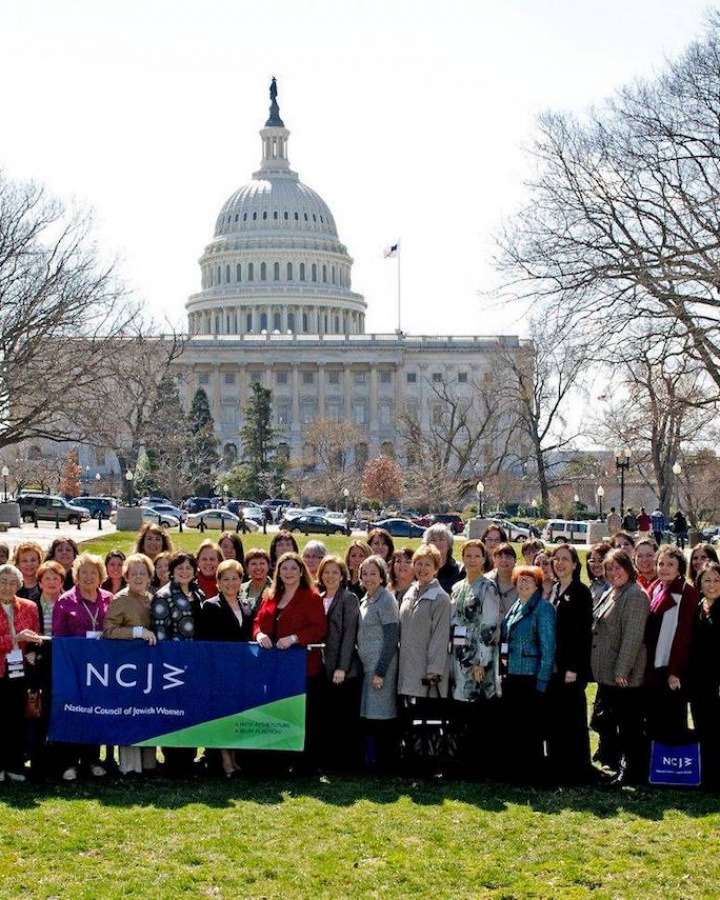
NCJW members rally at the United Nations to end human trafficking.
Photo: Vincent J. Ricardel


National Council of Jewish Women Rallies at United Nations to Call for End to Human Trafficking


March 4, 2005, NEW YORK, NY - The National Council of Jewish Women (NCJW), rallying at the United Nations today, launched a campaign to combat human trafficking with the hopes of protecting women, children, and families. Hundreds of NCJW members and supporters took action at Dag Hammarskjold Plaza across from the United Nations as part of their triennial convention. Following the rally, NCJW leaders hand delivered a letter to UN Secretary Kofi Annan (letter below) to urge greater UN action against the scourge of global trafficking.

With an estimated 600,000–800,000 people trafficked worldwide in 2004 alone, human trafficking is a $5.7 billion a year industry, according to UN estimates. Women, who make up 80 percent of the victims trafficked across international borders and can be sold many times, are particularly vulnerable, as are children. Both groups are predominantly trafficked for the purposes of prostitution, sweatshop industries, domestic work, forced labor, and entertainment.

Since its founding more than 100 years ago, NCJW has worked to protect women and children. At the turn of the twentieth century, NCJW spoke out against exploitation and forced labor. Beginning in 1903, at the behest of the US government, NCJW provided assistance to young female immigrants arriving alone and without resources at Ellis Island -- an effort the organization ultimately brought to over 250 cities protecting them from trafficking and exploitation. By 1923, NCJW had assisted over 65,000 immigrants in eastern port cities alone.

“Human trafficking is an international crisis that requires the immediate attention not only of the United Nations but also of concerned citizens worldwide,” said Marsha Atkind, president of NCJW. “We applaud UN Secretary-General Kofi Annan’s recent comments recognizing the odious nature of trafficking, in particular, as it impacts the quest for female equality. We could not agree more. Human trafficking is truly one of the great human rights tragedies of our time.”

The rally coincided with the 49th session of the United Nations Commission on the Status of Women, which began this week and runs through March 11. The UN conference aims to review and appraise the implementation of the Beijing Declaration and Platform for Action adopted at the Fourth World Conference on Women (1995).

Speaking to NCJW’s members and supporters, Florrie Burke, Senior Director, International Programs Anti-Trafficking and SOLACE Program for Survivors of Torture and Refugee Trauma Safe Horizon, issued an emotional call to action.

“The crime of human trafficking needs to be stopped. Buying and selling of human beings into forced labor and prostitution in this country is hidden, is widespread, is criminal and it violates human rights. Modern day slavery is an issue that should be at the top of everyone's agenda so that it can be eradicated and the tens of thousands brought into our country yearly for this purpose can be free,” she said.

The rally at Dag Hammarskjold Plaza is the kick-off event of a new NCJW action campaign against human trafficking. NCJW members will continue to take action to bring increased attention to this global crisis.

“Concrete measures must be taken by all of the countries of the world to eliminate the tragic business of marketing human beings for exploitation,” Atkind added. “Because if we don’t speak out and demand action, who will?”

NCJW is a volunteer organization, inspired by Jewish values, that works to improve the quality of life for women, children, and families and to ensure individual rights and freedoms for all through its network of 90,000 members, supporters, and volunteers nationwide.


Via Hand Delivery and Facsimile

The Honorable Kofi Annan
Secretary-General
United Nations
UN Plaza
New York, NY 10017

March 4, 2005

Your Excellency Kofi Annan,

On behalf of the 90,000 members and supporters of the National Council of Jewish Women (NCJW), I am writing to express our deep concern about the persistent problem of human trafficking and the lack of progress on this critical issue.

As the Ten-Year Review and Appraisal of the Fourth World Conference on Women in Beijing (1995) takes place in the Commission on the Status of Women’s 49th session, hundreds of NCJW members are gathered today in Dag Hammarskjold Plaza. We are here to urge increased attention and action against human trafficking. Although the status of women worldwide has improved as a result of the implementation of the Platform for Action drafted at the Beijing conference, there are several critical areas in which women and young girls remain especially vulnerable, most particularly in human trafficking.

This is not a new issue for NCJW. At the turn of the twentieth century, our organization spoke out against “white slavery” exploitation and sweatshop labor, at international women's conferences and in the United States. Beginning in 1903, at the behest of the US government, NCJW provided assistance to young female immigrants arriving alone and without resources -- an effort the organization ultimately brought to over 250 cities. By 1923, NCJW had assisted over 65,000 immigrants in eastern port cities alone. This historical dedication to the prevention of the exploitation of women and children strengthens our commitment to addressing the human trafficking problem today.

In 2004, the US government estimated that 600,000–800,000 people were trafficked worldwide. Women -- who make up 80 percent of the victims trafficked across international borders -- are particularly vulnerable, as are children. Both groups are predominantly trafficked for the purposes of prostitution, sweatshop industries, domestic work, forced labor, and entertainment. In fact, according to UN estimates, human trafficking, in which women and children can be sold many times, is a $5.7 billion-a-year industry.

We applaud your comments noting the odious practice of trafficking, especially as it impacts the quest for female equality. And we urge you to use your leadership to bring this issue to the forefront and to address this immediate crisis. Concrete measures simply must be taken by all of the countries of the world to eliminate the tragic business of marketing human beings for exploitation.

In particular, the Platform for Action -- relied upon by most UN member states as they design and implement policies to advance gender equality and the empowerment of women and girls -- currently lacks a strong anti-human trafficking component. In effect, this document may permit countries to ignore this critical human rights issue. It is crucial for the UN and the participants of the Ten-Year Review and Appraisal to actively address human trafficking, including methods to prevent trafficking, to provide more assistance and protection to victims and survivors, and to eliminate impunity for offenders.

NCJW is committed to addressing the human trafficking problem not only in the United States and in Israel but worldwide, since the impact of globalization forces us to examine trafficking from an international and multi-dimensional perspective.

Although we recognize the United Nations' continued efforts to end discrimination against women and reduce gender gaps in a variety of areas addressed in the Platform, we hope that, with your support, the Ten-Year Review and Appraisal session will be a major step by the UN to actively address the growing crisis of human trafficking, especially for women and young girls.

Sincerely,
Marsha Atkind
NCJW President

Contact:
Rabinowitz/Dorf Communications
202 265 3000


HOME | GET ACTION ALERTS | CONTACT US | LEADERSHIP LOG-ON SEARCH
©2008 National Council of Jewish Women